
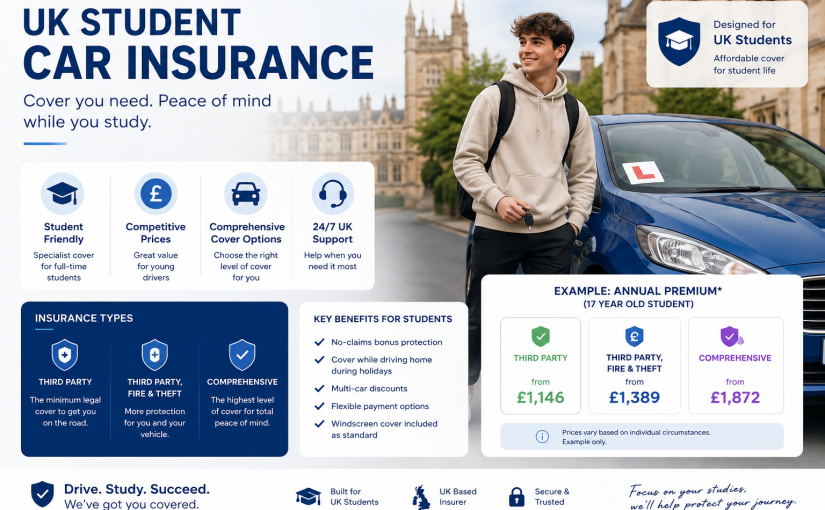
In the UK, student car insurance is a costly "rite of passage" with a distinctly British character. According to the latest industry data from 2026—sourced from GoCompare, MoneySuperMarket, and RAC—young UK drivers aged 17 to 19 face steep average annual premiums.
Car insurance pricing in the UK is driven entirely by big-data algorithms, creating a very harsh landscape for young, inexperienced student drivers. Here is a comprehensive, in-depth guide to student car insurance in the UK:
The Three Core Tiers of UK Car Insurance (Challenging Conventional Wisdom)
In the UK, car insurance is categorized into three statutory levels. Many students mistakenly believe that "choosing the most basic level is bound to be the cheapest," but UK market data shows the exact opposite:
| Insurance Class | Scope of Coverage | Price Paradox (Cost Characteristics) |
|
Comprehensive
|
Covers compensation for third-party bodily injury and property damage, as well as damage to, theft of, or fire damage to your own vehicle. | 💰 Often the cheapest option! Although it offers the most comprehensive coverage, statistically speaking, "high-risk" or reckless drivers tend to purchase the most basic insurance plans. This dilutes the risk profile of the comprehensive insurance pool, making it—counterintuitively—cheaper than TPO coverage. |
|
Third Party, Fire and Theft (TPFT)
|
Compensation for third-party losses, plus the loss resulting from the theft or burning of your own vehicle. | ⚖️ Mid-range pricing. Suitable for a few specific situations—such as driving an old car with very low value where a comprehensive insurance quote is excessively high. |
|
Third Party Only (TPO)
|
The minimum legal requirement for driving in the UK. It covers only the other party's personal injury and property damage resulting from an accident, but provides no compensation for damage to your own vehicle. | 💸 Often the most expensive option! Insurance companies categorize drivers who default to purchasing only third-party liability coverage as a "high-risk group trying to save money"; consequently, big data analysis drives up their base premiums. |
A mechanism unique to the UK: Car insurance groups (Insurance Groups 1–50)
All vehicles sold in the UK are strictly classified by Thatcham Research into insurance groups ranging from 1 to 50. The lower the number, the lower the insurance premium.
When buying a car in the UK, university students should strictly stick to insurance groups 1 through 10 (e.g., Skoda Citigo, KiaThe critical threshold for students choosing a car: Picanto, Volkswagen Up!, or low-horsepower versions of the Ford Fiesta).
Pricing logic: Insurance groupings are determined not only by engine displacement but—more importantly—by factors such as the cost of parts and repairs, safety ratings, and the likelihood of theft. The insurance premium for an older BMW in Group 30 valued at £3,000 could be more than three times that of a newer, small-engine Japanese car in Group 2 valued at £8,000.
A Money-Saving Powerhouse for College Students: Telematics (Black Box) Insurance
For UK students with no prior driving history, the most direct way to lower insurance premiums is to opt for telematics-based monitoring of driving behavior.
Operational Model: Insurance companies (such as Admiral Littlebox, Hastings YouDrive, and Marmalade) install a small device—a "black box"—in your vehicle or require the use of a mobile app paired with a Bluetooth tag to monitor metrics in real-time, including speed, frequency of hard braking, cornering smoothness, and mileage.
The Critical "Nighttime Curfew": Many "black box" insurance policies in the UK include contractual restrictions that strictly prohibit driving between midnight and 5:00 AM; driving during these hours results in a significant loss of safety points, causing renewal premiums to skyrocket. Students must carefully check for curfew clauses when purchasing a policy.
Benefits: With good driving habits, black box insurance can typically help students save 30% to 40% on what would otherwise be exorbitant premiums during their first year.
A UK Legal Red Line You Must Never Cross: "Fronting"
Because insurance premiums for young students are prohibitively expensive, many international students from the UK and their families attempt to take "shortcuts"—but in the UK, this constitutes a serious criminal offense involving fraud.
What is fronting?
This refers to the practice of registering a parent or an older person with extensive driving experience as the vehicle's "Main Driver" when purchasing insurance, while the student is actually the one driving the car the vast majority of the time (with the student merely listed as a "Named Driver").
UK insurance companies can now easily detect such misrepresentation by cross-referencing data from road network CCTV, gas station card transaction records, and big data regarding school commutes. Once a policy is determined to involve "fronting":
Immediate invalidation of insurance (Void): In the event of an accident, the insurance company can legally refuse the claim, leaving you liable for third-party claims amounting to hundreds of thousands of pounds.
Criminal record: Under the UK Fraud Act, this constitutes insurance fraud and can lead to direct prosecution.
Permanent loss of driving privileges: Your details will be entered into the UK’s Insurance Fraud Enforcement Department (IFED) database; no mainstream UK insurer will provide coverage in the future, and it could even result in the revocation of your UK visa or permanent residency (PR).
6 Golden Rules for Legally and Compliantly Lowering Car Insurance Costs for Students in the UK
Since resorting to shady or illicit methods is out of the question, how can students legitimately save money on UK car insurance by exploiting actuarial loopholes?
Legitimately add a "Named Driver": While keeping yourself as the primary driver, add an older person (such as a parent, relative, or senior student) with a full, long-term UK or EU driving license and a clean driving record as a secondary driver. Insurers view the presence of an experienced driver as a risk-mitigating factor, which can immediately cut hundreds of pounds off your premium.
Purchase 20 to 26 days in advance (the "Golden Window"): Big data from MoneySuperMarket confirms that submitting your order 20–26 days before the policy takes effect yields the lowest price. Insurers perceive drivers who plan their car insurance a month in advance as organized, rational, and lower-risk; conversely, waiting until the day before you start driving can increase premiums by as much as £160–£230.
Voluntarily increase your "Voluntary Excess": UK car insurance deductibles (excess) consist of a "Compulsory Excess" and a "Voluntary Excess." You can choose to raise your voluntary excess to £250 or £500 to significantly lower your premium—provided, of course, that you have the funds available to pay this amount yourself in the event of a claim.
Opt for an annual payment instead of installments: Paying in installments is essentially the insurer lending you money to buy the policy; the Annual Percentage Rate (APR) is often higher than that of a standard credit card, and an additional 12% Insurance Premium Tax (IPT) is charged. Students should aim to pay the full annual premium upfront.
Accurately estimate your annual mileage: Do not blindly overestimate your mileage when getting a quote. Life around UK university campuses is convenient, and many students drive less than 5,000 miles a year. Lowering your estimated mileage can reduce premiums, but never deliberately under-report (e.g., claiming 3,000 miles when you actually drive 10,000).
Provide your UK driving license number: Honestly entering the driving license number issued by the UK's DVLA when requesting a quote establishes much higher initial trust than using a Chinese license or an International Driving Permit translation. Insurers can verify this directly through their systems and offer precise rate discounts.