
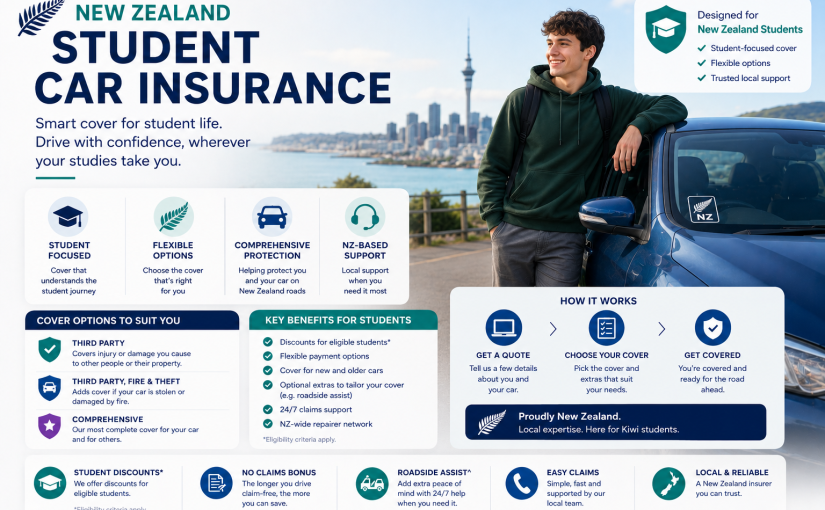
The way student car insurance operates in New Zealand differs fundamentally from systems in the US, UK, Canada, and Australia. While New Zealand boasts a unique national compensation scheme for traffic-related injuries, it is equally uncompromising when it comes to the financial penalties young drivers face for property damage.
According to the latest 2026 data from the consumer watchdog Consumer NZ and the leading comparison platform Quashed, comprehensive car insurance premiums for young people in major cities like Auckland far exceed the national average (which is approximately NZ$1,267 per year for comprehensive coverage). Due to factors such as a lack of long-term driving history and differences in driving habits, students can easily find themselves facing complex challenges when purchasing insurance in New Zealand.Here is a comprehensive, in-depth guide to student car insurance in New Zealand:
A Fundamental Shift: The Non-Compulsory Auto Insurance System and the ACC Scheme
New Zealand is a "global exception" when it comes to auto insurance laws:
Car insurance is not legally mandatory:
In New Zealand, the law does not require you to purchase any car insurance—including third-party liability coverage—in order to drive on the road. This differs completely from regulations in countries such as those in Europe, North America, and Australia, where driving without car insurance is illegal.
Why is it not mandatory? — The powerful ACC (Accident Compensation Corporation)
New Zealand operates a "no-fault personal injury compensation" system. Regardless of who is at fault for a traffic accident, if someone is injured or killed on the road, 100% of medical and rehabilitation costs—as well as a portion of long-term lost wages—are covered by the Accident Compensation Corporation (ACC), a New Zealand government agency.
Source of funds: These substantial funds have already been automatically collected through your vehicle registration (Rego) and fuel taxes. In New Zealand, you absolutely cannot sue another driver for massive compensation in the event of personal injury.
Why Are Students Still "Required" to Buy Insurance? — The Bottomless Pit of Property Loss
Although ACC covers personal injury, it provides no compensation whatsoever for any property damage (such as wrecked vehicles, damaged streetlights, houses, or public facilities).
🚨 A real-life pitfall for international students: Imagine a student without insurance accidentally rear-ends a Tesla or crashes into a roadside shop. While the other party cannot sue you for personal injury costs, their insurance company will pursue you personally—indefinitely—through legal channels to recover tens or even hundreds of thousands of New Zealand dollars for vehicle repairs and property damage. Inability to pay leads directly to personal bankruptcy, the total destruction of your credit rating, and deportation. That is why over 90% of drivers in New Zealand voluntarily purchase commercial auto insurance.
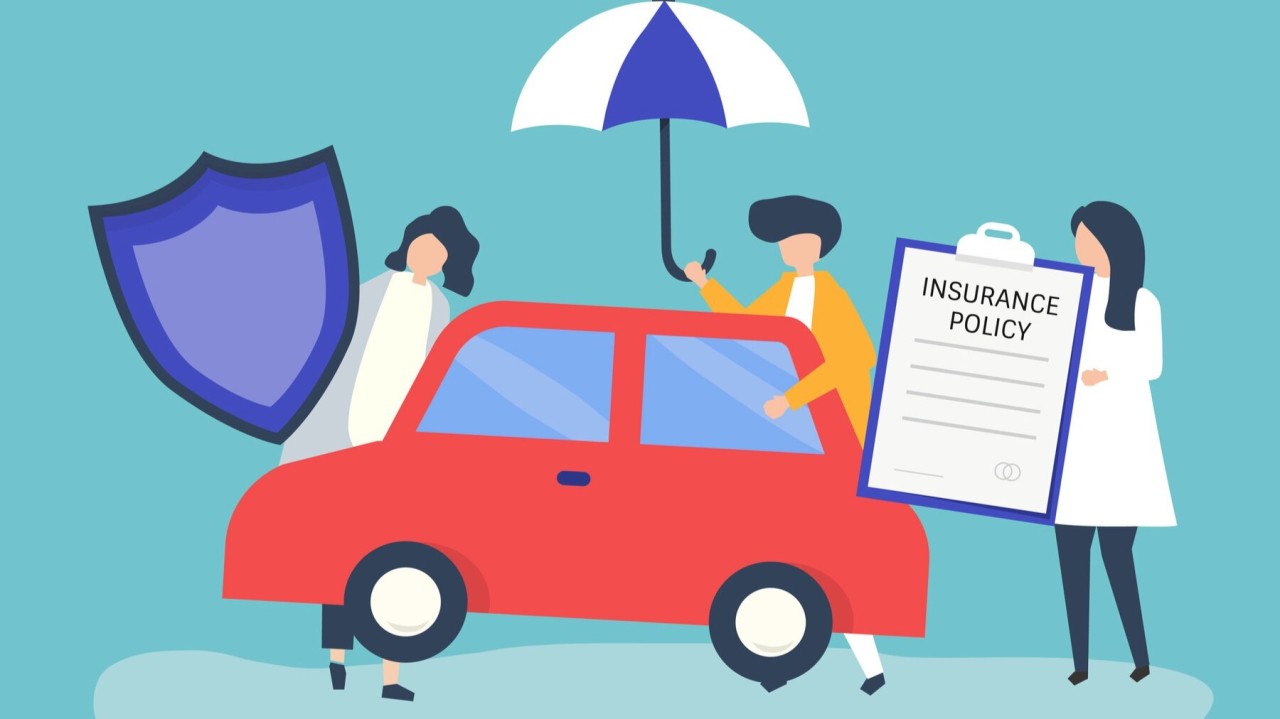
The "Veto Power" of the Graduated Driver Licensing System (GDLS) Over Auto Insurance
New Zealand implements a strict Graduated Driver Licensing System consisting of three stages: Learner, Restricted, and Full.
This system not only determines when you can drive but also directly determines whether your insurance is valid:
Legally binding driver's licence conditions:
Learner Licence: You must be accompanied by a supervisor in the front passenger seat who has held a full licence for at least two years, and "L" plates must be displayed on the front and rear of the vehicle.
Restricted Licence: You may drive unaccompanied between 5:00 AM and 10:00 PM; driving unaccompanied is strictly prohibited between 10:00 PM and 5:00 AM (unless accompanied by a supervisor); carrying passengers is strictly prohibited (except for a spouse, financially dependent children, or parents).
Insurance companies' "one-vote veto" clauses:
All car insurance policies in New Zealand contain a key legal disclaimer: "Driving must comply with licence conditions." If a learner driver holding a "Restricted" licence drives classmates out for a late-night snack at 11 PM and is involved in a crash, the insurance company will deny the claim 100%, regardless of who was at fault. You would not only have to cover all repair costs yourself but also face police prosecution for violating the conditions of your licence.
The "Excess Stacking" Trap That Must Not Be Overlooked
In New Zealand, student drivers under the age of 25 face a cumulative excess mechanism—specific to the region—when making insurance claims. A 2026 market audit revealed that, due to the high accident rate among young drivers, the total excess applied by some insurers to young drivers holding restricted licenses can exceed NZ$1,350.
When filing a claim as the at-fault party, the deductible you are required to pay is the sum of the following components:
Standard Excess: Typically $400–$600 NZD.
Age Excess: Drivers under the age of 25 are usually subject to a mandatory additional excess of $500–$800 NZD.
Licence Excess: Drivers holding a Learner or Restricted licence face an additional surcharge of several hundred dollars, as actuarial models classify them as an "inexperienced group."
💡 Money-saving tip: AMI, one of New Zealand's largest local insurance companies, offers a "Young Driver Excess Reduction" benefit. Students under the age of 25 can earn a "Safe Driver" certificate by completing AMI's online safe driving course. In the event of an at-fault accident later on, this certificate allows them to waive the additional young driver excess—saving them several hundred dollars.
Comparison of the Three Main Commercial Vehicle Insurance Tiers in New Zealand
In New Zealand, the cost of commercial vehicle insurance typically drops significantly as the scope of coverage is reduced. Students on a limited budget can make a smart choice based on the vehicle's value:
| Insurance Product Tier | English Name | Scope of Coverage | Suitable Student Profiles and Pitfalls to Avoid When Choosing a Car |
| Comprehensive Insurance | Comprehensive | Compensation for the other party's losses + compensation for damage to your own vehicle + coverage for theft, fire, or severe weather (such as hailstorms or floods). | 🚙 Suitable for cars valued at over NZD $6,000. When purchasing comprehensive insurance in New Zealand, you should opt for **Agreed Value** rather than Market Value to lock in the payout amount in the event of a total loss. |
| Third-party liability, fire, and theft insurance | Third Party, Fire & Theft | It only covers the other party's losses; your own vehicle is covered only if it is stolen or destroyed by fire. | 🔒 Suitable for students on a tight budget who own vehicle models at high risk of theft (such as older Toyota Aquas or Mazda Demios—favorites among ram-raiders in New Zealand). |
| Pure third-party liability insurance | Third Party Only | It only covers the damage you cause to other people's vehicles and property; if your own car is wrecked, you have no choice but to send it to the scrapyard yourself. | 💰 Lowest premiums (usually $100–$200 per year). Ideal for low-value used "beaters" worth a few thousand dollars—cars you wouldn't mind wrecking—while fully hedging against the risk of bankruptcy from colliding with a luxury vehicle. |
Compliance Boundaries for International Students Purchasing Insurance in New Zealand
If you are an international student studying in New Zealand and hold an overseas driver's license, you must strictly adhere to the following legal timeframes set by the New Zealand Transport Agency (NZTA):
12-Month Legal Validity Period: Upon each entry into New Zealand, international students may legally drive for up to 12 months using their original, valid, full overseas driver's license accompanied by a translation recognized by the transport authority (such as a NAATI translation or an NZTA-approved translation service).
Risks of Insurance Invalidation and Legal Violation: Once you have resided in New Zealand continuously for more than 12 months, you are required to convert your overseas license into a local New Zealand driver's license at an authorized location (this typically involves passing a theory test, with a practical driving test also required for applicants from certain countries). If you continue to drive using your Chinese license beyond this 12-month period without converting it, you are legally classified as driving without a license. Consequently, your car insurance policy becomes void, and any claims resulting from an accident will be denied.
Smart Ways to Save on Student Car Insurance in New Zealand (2026)
Avoid "High-Theft Risk" Models:
Vehicle theft by youths—including "ram-raids"—has become a frequent issue in New Zealand recently. Insurance companies are particularly wary of compact cars like the Toyota Aqua, Mazda Demio, and Nissan Tiida, as they often lack electronic engine immobilizers. If students under 25 purchase these models, premiums can double, and some insurers may even refuse coverage entirely. Always verify that the vehicle is equipped with an anti-theft alarm before buying.
Embrace Digital Insurers:
Beyond traditional giants like AA Insurance, State, and AMI, highly digital insurance providers such as Cove Insurance and Tower have emerged in New Zealand. These companies avoid the overhead costs of extensive physical branches and manage policies entirely via mobile apps; their quotes are typically 20%–35% lower than established insurers, and they offer flexible, no-lock-in contracts.
Accurately Declare Where the Vehicle Is Parked:
In New Zealand, where a vehicle is parked—whether in a locked garage, a private driveway, or on the street—can affect premiums for young drivers by as much as 15%. If your rental property includes a garage, be sure to declare it to secure a discount on your premium.
Opt Out of Unnecessary Add-ons:
When selecting comprehensive coverage, systems often automatically include options like "excess-free glass cover" or "roadside rental car service." Students on a tight budget can choose to remove these add-ons (glass coverage alone often costs around $50/year) to minimize the base premium.