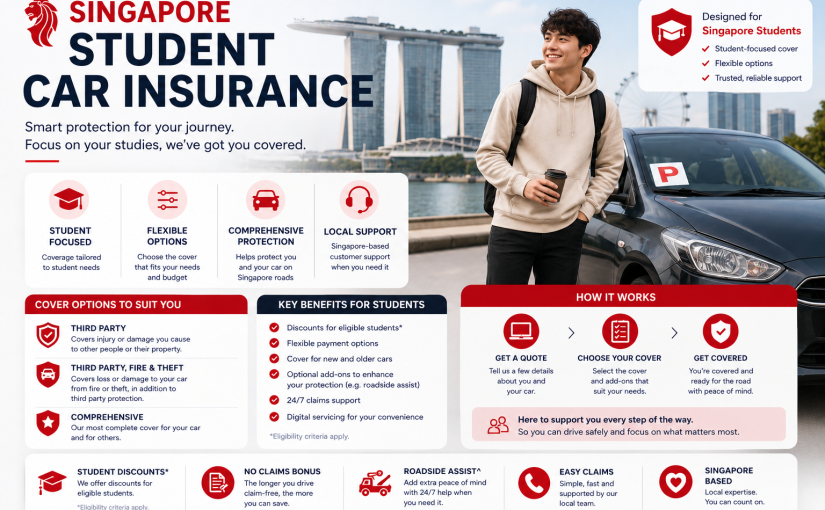
In Singapore, the costs of purchasing and maintaining a vehicle are among the highest in the world, driven by expenses such as the Certificate of Entitlement (COE) and the steep Additional Registration Fee (ARF). For university students and young novice drivers, this substantial initial investment is immediately followed by stringent insurance premium structures targeting "Young and/or Inexperienced Drivers" (YID).
In Singapore, car insurance premiums for students are often two to three times higher than those for experienced drivers. The following is a comprehensive, in-depth guide to student car insurance in Singapore.
Three Basic Tiers of Singapore Car Insurance and Statutory Thresholds
Under Singapore's Motor Vehicles (Third-Party Risks and Compensation) Act, all vehicles driven on public roads must be covered by at least third-party liability insurance; failure to do so constitutes a serious criminal offense.
| Insurance Class | English Name | Scope of Coverage | Price and Suitability for Students |
| Comprehensive insurance | Comprehensive | Covers compensation for third-party bodily injury and property damage, while also insuring your own vehicle against damage (such as from accidents, falling trees, or sudden flooding/ponding), theft, or fire. | 🚙 Highly recommended. Car prices in Singapore are extremely high—even used vehicles come with a hefty price tag—making comprehensive insurance the standard choice for the vast majority of student car owners and families. |
| Third-party, fire, and theft insurance | Third Party, Fire & Theft (TPFT) | It covers compensation for third-party losses, and additionally, the insurance company will only pay for damage to your own vehicle if it catches fire or is stolen. | 🔑 Suitable for purchasing used cars that are over 10 years old, nearing the end of their service life, and have very low asset value. |
| Pure third-party liability insurance | Third Party Only (TPO) | The minimum legal requirement for driving in Singapore. It covers only compensation for the other party's (third party's) personal injuries and property damage resulting from an accident, but provides no compensation for damage to your own vehicle. | 💸 Although the premiums are the lowest, you would have to cover the full cost of repairs yourself in the event of an at-fault accident—posing a significant risk for students who are not yet financially independent. |
A Financial Nightmare for Students: The "Young/Novice Driver Excess" (YID Excess)
For students purchasing car insurance in Singapore, the biggest financial pitfall is often not the premium itself, but the issue of "excess stacking" when making a claim. Insurance companies in Singapore generally classify the following groups as high-risk:
Young Driver: Typically under the age of 25 or 27.
Inexperienced Driver: Has held a valid driver's license for less than two years.
If you are determined to be the at-fault party in a car accident, you must first pay the following deductibles out of pocket before the insurance company begins covering the cost of repairs:
Standard/Compulsory Excess: Applies to everyone; typically ranges from SGD 500 to SGD 1,000 (e.g., Budget Direct defaults to SGD 600).
Additional Excess for Young/Inexperienced Drivers (YID Excess) — A major pain point: Most insurers (such as AIG, MSIG, and Singlife’s basic plans) impose an additional excess of SGD 2,000 to SGD 3,000 specifically for YID drivers.
Unnamed Driver Excess: If you drive your parents' car without being listed as a "Named Driver" on the policy, an additional excess of SGD 1,500 to SGD 2,000 will be applied in the event of a claim.
💥 A "brutal" claims scenario: A 20-year-old university freshman—who has held a driver's license for just one year—accidentally rear-ends another vehicle while driving their parents' car (on which they are not listed as a named driver). When filing a claim, they could face a total upfront cost of SGD 4,600: a standard excess of $600, a "Young/Inexperienced Driver" (YID) additional excess of $2,500, and an unlisted driver excess of $1,500. If the repair costs do not exceed this amount, the insurance coverage is effectively useless.
Overview of Student/Novice Insurance Policies from Major Singaporean Insurers for 2026
To compete in a demanding market, major Singaporean insurers have introduced various actuarial schemes and waiver benefits tailored to young drivers:
Singlife: Special Waiver for Young Drivers
Its "Motor Prestige" plan stands out in the industry by explicitly waiving all additional excesses ($0 Additional Excess) for young or inexperienced drivers. Although the initial premium is higher, it serves as a highly cost-effective "safety net" for students who drive frequently and wish to avoid hefty out-of-pocket expenses.
Budget Direct: Exceptional Value and Precision Customization
Offers highly competitive base premiums with a standard excess set at around SGD 600. Students with good driving habits and limited budgets can further lower their premiums by customizing and increasing the "Voluntary Excess" via the company's website.
HLAS (HL Assurance): Exclusive Discounts for Young Drivers
Frequently offers new young car owners premium discounts of up to 25% and provides an optional rider to reduce the young driver excess—making it an excellent choice for recent university graduates or young car owners just entering the workforce.
AAS (Automobile Association of Singapore) & Safe Driver Program
AAS has partnered with select insurers to launch telematics-based plans tailored for young or novice drivers. By completing a 4-hour safe driving course, passing the assessment, and using a dedicated mobile app to track good driving behavior over six months, students can reduce additional excess charges by up to SGD 2,000 and enjoy a 10% discount on premiums.
AIG & DirectAsia:
AIG offers an excess reduction benefit specifically for using in-car cameras (reducing excess by up to SGD 500–1,000). DirectAsia is renowned for its NCD60 scheme (offering a massive 60% discount for five consecutive years without claims), making it ideal for students planning to drive locally long-term and build up their insurance track record.
Singapore’s Unique “No-Claim Discount” (NCD) and Tips for Students on “Piggybacking” on Wi-Fi
In Singapore, the most legitimate tool for lowering car insurance costs is the No Claim Discount (NCD). The premium discount increases for every year without a claim:
1 year = 10% | 2 years = 20% | 3 years = 30% | 4 years = 50% | 5 years or more = 50%
The student's dilemma: Students who have just obtained their driver's license start with an NCD of 0%, meaning their insurance premiums are at their peak.
A legitimate strategy to save on premiums: If the vehicle is shared within the family, it is highly recommended to designate a parent—who holds a 50% NCD—as the "Main Driver," while adding the student as a "Named Driver." This approach not only allows the student to benefit from the parents' 50% premium discount but also ensures they are properly covered in the event of an accident, thereby avoiding the hefty excess fees (deductibles) imposed for "unnamed drivers."
A Guide for International Students Driving in Singapore: Compliance and Insurance Pitfalls to Avoid
For overseas students who have come to Singapore alone to study, there are strict compliance interfaces between the Land Transport Authority (LTA) and insurance companies:
The 12-Month Deadline for Converting Foreign Driver's Licenses:
Singapore law stipulates that overseas students holding long-term visas (such as a Student's Pass) may only drive using their original valid foreign driver's license accompanied by an official translation for a maximum of 12 months from the date of entry.
Critical Pitfall:
After the 12-month period expires, you must pass Singapore's Basic Theory Test (BTT) and convert your foreign license to a local Class 3 or 3A license. Continuing to drive without converting your license constitutes driving without a valid license under the law. In the event of a collision, all insurance coverage—including comprehensive and third-party policies—becomes immediately void, meaning the insurance company will not pay a single cent; furthermore, the student faces criminal penalties, including police arrest and visa cancellation.
Used Car COE Expiration and Insurance Refunds:
Since international students typically remain in Singapore for 2–4 years, they often prefer purchasing older used cars with limited remaining COE (Certificate of Entitlement) validity—usually 2–3 years. When purchasing car insurance, it is essential to confirm with the broker that the policy allows for a pro-rata refund. This ensures that upon graduating and selling or scrapping the vehicle, you can apply to the insurance company for a refund of the premiums covering the remaining months.
5 Highly Effective, Legitimate Ways to Lower Insurance Premiums for Students in Singapore
Stick to low-risk, practical vehicles (avoiding performance models):
When buying a car in Singapore, steer clear of models labeled "Turbo" or "Sports," or those with an engine displacement exceeding 1.6L. Prioritize popular Japanese or Korean compact cars (such as the Toyota Vios or Honda Jazz), as they carry the lowest insurance risk ratings.
Opt for insurer-designated workshops:
When purchasing comprehensive coverage, selecting "Authorized Workshops Only" is about 20% cheaper than the "Any Workshop" option.
Embrace the "Off-Peak Car" (OPC) scheme:
If you only drive during weekends or off-peak hours (7 PM to 7 AM on weekdays), consider buying or converting to an OPC. Not only does this offer an annual road tax rebate of up to S$500, but insurance companies also provide significant premium discounts.
Don't skimp on a dashcam:
Insurers like AIG and Budget Direct explicitly state that if a compliant front-and-rear dashcam is installed and footage can be provided to the police and the insurer in the event of an accident, you are eligible for an "Excess Waiver."
Avoid filing claims for minor scratches:
Given the high "Young and Inexperienced Driver" (YID) excess applicable to students, do not file an insurance claim for minor incidents—such as a low-speed scrape while reversing or a small patch of chipped paint—that cost only a few hundred dollars to repair. Doing so would force you to pay an excess of several thousand dollars out of pocket, cause your premiums to double the following year, and potentially result in the loss of your limited credit eligibility.