
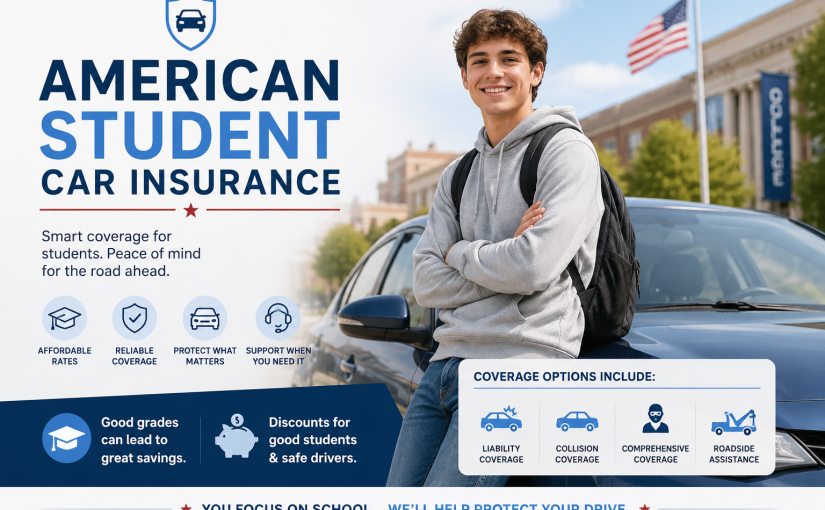
In the United States, student car insurance is a significant expense that is both a headache and a necessity for countless international students and American families. The U.S. auto insurance system is extremely mature and entirely based on risk-based pricing. Because drivers under 25 have a statistically high accident rate, initial quotes from U.S. insurance companies for students are often exorbitant.
Based on the latest data and industry policies from authoritative financial institutions such as Mercury, CNBC, Bankrate, and Allstate, the following provides a comprehensive and in-depth guide to U.S. student car insurance:
Current Costs: The Painful "Price of Youth"
In the United States, young students who purchase insurance policies independently typically pay between $250 and $450 per month, with annual premiums often reaching $3,000 to $5,500.
Insurance companies generally offer two completely different underwriting pathways, with a significant difference in premiums:
| Insurance application process | Average annual premium (Full Coverage) | Advantages and disadvantages analysis |
|
Family Policy (or Family Insurance Policy) |
Approximately $1,700 - $2,600 | 💰 Most cost-effective. Shares parents' good credit scores and driving experience. However, if the student is involved in an accident, the whole family's insurance premiums will skyrocket. |
|
Individual Policy |
Approximately $3,700 - $5,500 | 💸 Extremely expensive. Suitable for completely independent students who are the sole owners of the vehicle or international students (F-1/J-1) traveling to the US alone. |

The core product structure of US auto insurance
US car insurance isn't a "one-size-fits-all" solution; it's composed of multiple modules that can be freely combined. Students are typically required to meet the minimum coverage limits stipulated by each state and can add coverage as needed based on their budget.
Liability Coverage – Legally Mandatory:
Bodily Injury: Covers medical expenses for the other driver or passengers caused by your fault.
Property Damage: Covers damage to other vehicles or public facilities (such as utility poles or fences) that you hit.
Collision Coverage – Loan Mandatory: Covers repair or total replacement costs for your own vehicle, regardless of fault. Banks will check this if the car is financed or leased.
Comprehensive Coverage: Covers losses not caused by collisions, such as a car window being smashed while parked on campus, catalytic converter theft, hail damage, or hitting a deer.
Personal Injury Protection/Medical Payments (PIP): Pays medical expenses for you and your passengers, regardless of fault.
Uninsured/Underinsured Motorist Coverage: This insurance covers you if the person who hits you flees the scene or is uninsured.
Four core money-saving discounts: a "special buff" for students.
Since insurance premiums are high, American insurance companies have also tailored four major discounts for students. These discounts are stackable!
1. Good Student Discount:
US insurance companies believe that academically disciplined students are also more reliable drivers.
Requirements: Full-time students aged 16-25, maintaining a GPA of 3.0 (B average) or higher, or ranking in the top 20% of their class, or being listed on the Dean's List.
Amount: Allstate students can receive up to 22.5% off (sometimes even a GPA of 2.7 can trigger a partial discount); State Farm students can receive up to 25% off; GEICO and USAA students consistently receive around 10%-15%.
2. Distant Student Discount (Student Away at School):
Requirements: The student attends a university in another city, typically more than 100 miles (approximately 160 kilometers) from home, and does not bring a car to school (the car is left in the parents' storage room).
Benefits: Insurance premiums will drop dramatically. This is because insurance companies assume you will only drive during Thanksgiving, winter or summer breaks when you go home.
Dedicated Safe Driving Training (Driver Training / Teen Programs):
Major companies offer app-based courses specifically designed for young drivers:
State Farm's Steer Clear®: Drivers under 21 who complete a certain amount of crash-free simulation and safety courses unlock significant discounts.
Allstate's TeenSMART: Dedicated defensive driving training for teenagers with discounts.
A powerful tool for the smart era: Telematics (behavioral tracking car insurance)
This is currently the most popular way for American college students to save on insurance premiums. Students voluntarily allow insurance companies to monitor their daily driving behavior through mobile apps or in-car OBD devices.
Tracking indicators: Whether there was sudden braking, whether driving late at night (1 AM - 4 AM), whether speeding, and whether using a mobile phone while driving.
Mainstream plans: Allstate's Drivewise, Progressive's Snapshot, State Farm's Drive Safe & Save, and USAA's SafePilot.
Benefits: If you drive responsibly and go to and from school on time, you'll receive a 10% discount upon first enrollment, and can enjoy premium reductions of up to 30% - 40% on renewals.

2026 Review of Student Insurance Policies from Major US Insurance Companies
According to the latest evaluation, the following giants each have their own unique characteristics in the student market:
GEICO (The Most Affordable Choice for the Common People): Whether joining a family policy or opening an individual account, its base price is highly competitive nationwide, and the application process for the student discount is very user-friendly.
State Farm (The Top Choice for Young Independent Drivers): Offers the most generous "student + Steer Clear driving training" double discount in the nation, making it the most cost-effective option for students under 25 who must purchase their own insurance.
Allstate (The Benchmark for High Coverage and High Discounts): Offers the highest Smart Student discount (22.5%), and its safety assistance and remote roadside assistance services are among the best in the nation.
USA (The Ceiling for Military/ROTC Members): Has the lowest rates in the nation. However, the eligibility requirements are extremely high, limited to US military personnel, veterans, university ROTC members, and their immediate family members.
Special Guide to Avoiding Pitfalls When Purchasing Insurance in the US for International Students (F-1/J-1)
If you are a newly arrived Chinese student studying in the US, you will face a significant disadvantage: zero driving experience and zero credit score.
The devastating impact of a Chinese driver's license: Although many states allow temporary driving for a few months with a Chinese driver's license and a translation, insurance companies consider a Chinese driver's license equivalent to "unlicensed" or at the lowest trust level, resulting in exorbitant premiums. Obtain a local State Driver's License as soon as possible after arrival; this will instantly lower your insurance premiums.
Seeking channels to recognize your Chinese driving experience: Organizations specializing in serving international students, such as GradGuard, or some experienced Chinese insurance agents, can help international students convert their Chinese driving experience into equivalent credit scores or waive some credit checks.
Never falsify your address to save money (Rate Evasion): Some students, in an effort to save on insurance premiums, list their car insurance address as a friend's house in a rural area, while actually driving on campus in New York or Los Angeles. This is a criminal offense of insurance fraud in the US. In the event of a major accident, the insurance company will not only refuse to pay but will also prosecute you and leave a criminal record.

The impact of state laws on student bus insurance in the United States
In the United States, auto insurance regulation rests entirely with the state governments, not the federal government. This means that each of the 50 states has its own set of completely different auto insurance laws.
Because college students (especially drivers under 25) are considered a high-risk group with limited credit history and driving experience, even minor differences in state laws regarding pricing factors, liability systems, vehicle registration, and minimum coverage can significantly impact student auto insurance premiums and coverage options.
Below is a detailed breakdown of the key dimensions by which state laws affect student auto insurance:
Legal bans on rate pricing factors: Breaking the "young equals high-risk" curse
In most states, insurance companies calculate premiums based on a driver's age, gender, and credit history—three factors that are precisely where college students are vulnerable. However, some states have laws that explicitly prohibit or restrict the use of these factors, creating significant advantages or disadvantages for local students.
Age & Experience Ban: In Hawaii and Massachusetts, laws strictly prohibit insurance companies from using age or driving experience as a risk factor for premium assessment. In these states, 18-year-old college freshmen won't be charged exorbitant premiums simply because they are "young," resulting in a very favorable rate environment for young students.
Credit Score Ban: Laws in California, Hawaii, Massachusetts, Michigan, Maryland, Oregon, and Utah prohibit or significantly limit insurance companies from reviewing drivers' credit-based insurance scores when determining auto insurance rates. College students generally lack a long-term credit history. In states that allow credit scores (such as Texas or Florida), "zero credit" can lead to skyrocketing premiums; however, in the aforementioned states with bans, students' poor credit won't become a burden on premiums.
Gender Ban: Traditional statistics show that young men have a much higher rate of serious accidents than women, therefore, male students often have significantly higher initial premiums. But in California, Hawaii, Massachusetts, Michigan, Montana, North Carolina, and Pennsylvania, laws prohibit gender-based pricing for auto insurance, giving male students a breather in these states.
Differences in legal liability systems: "No-fault liability" vs. "Fault-based liability"
The legal systems governing traffic accident liability in different U.S. states directly determine the structure of student car insurance policies and the minimum premium.
No-Fault States (such as Michigan, New York, Florida, and New Jersey):
Legal Requirements: These states mandate the purchase of Personal Injury Protection (PIP) insurance. Regardless of who is at fault in a car accident, your own insurance company is obligated to cover medical expenses and lost wages for you and your passengers.
Impact on Students: This results in extremely high insurance premiums! Michigan, in particular, has consistently had some of the highest auto insurance rates in the nation due to its unique historical PIP regulations. If an out-of-state student attends a university in Michigan, the law mandates that they purchase Michigan-compliant no-fault auto insurance if their vehicle has been driven in the state for at least 30 days (cumulative or consecutive). Failure to do so will result in the loss of most legal recourse in the event of an accident.
Traditional fault-based liability (in states such as California and Texas):
In a car accident, the party at fault (or their insurance company) is required to compensate for all losses. In these states, student car insurance rates are relatively low, but if liability insurance coverage is too low, and the student is found at fault, they risk being sued and facing bankruptcy.
The "days trap" for interstate schooling and vehicle registration laws
Many students drive cars registered in their parents' names to colleges across state lines (e.g., from Texas to Michigan or California). In these cases, the laws of the state where the school is located impose strict deadlines on when the vehicle must be registered and insured locally.
| State examples | Legal time limit for vehicles to stay in the local area | Mandatory requirements for interstate university students |
| Michigan (MI) | More than 30 days | You must purchase local no-fault auto insurance that complies with Michigan law (even if the license plate is from out of state). |
| More than 90 days | The vehicle must be re-registered in the state and issued Michigan license plates. | |
| California (CA) | As long as you maintain your full-time student status | California law generally allows students to temporarily retain their out-of-state vehicle registrations, provided that their primary residence is still considered their parents' home (out-of-state) and they have paid non-resident tuition. |
⚠️ Legal requirements regarding "Garaging Address":
Even if the laws of the state where the school is located (such as California) allow out-of-state students to continue using their parents' insurance policies without changing license plates, the insurance company's terms are bound by the state's Insurance Authority laws. Students must change their "vehicle's permanent address" to the school address. Premiums will be recalculated based on the school's zip code. Concealing the school address and continuing to enjoy low premiums in one's rural hometown is legally defined as "rate evasion". In the event of a major accident near the school, the insurance company has the absolute legal right to refuse to pay out.
Significant differences in state minimum insurance coverage
Every car on the road in the United States must meet the minimum liability insurance coverage required by the laws of its respective state. The legal "minimum" limits vary significantly between states, which severely impacts students with limited budgets who only want the minimum coverage to drive legally.
Low-limit states (such as California and New Jersey): California's legal minimum requirement is only 15/30/5 (that is, $15,000 for bodily injury in one incident, $30,000 for total bodily injury in a single incident, and only $5,000 for property damage).
Impact: The basic premium seems cheap. However, if a student only buys this coverage, and accidentally hits a Tesla or luxury car near a California campus, the $5,000 property damage limit will be instantly exceeded. The remaining tens of thousands or even hundreds of dollars in debt will legally be forcibly repaid by the student and their family's assets.
High-bottom-line states (such as Alaska and Maine): The legal minimum requirements are usually 50/100/25.
Impact: The law has forcibly raised the entry threshold for students transferring in. Although the basic premium has been increased by law, it has actually created effective mandatory legal protection for students with extremely low risk tolerance.
Student auto insurance coverage in various U.S. states and territories
In the United States, auto insurance regulation rests entirely with the state and district governments, not the federal government. This means that the 50 states plus Washington, D.C., have 51 completely different auto insurance laws.
Because college students (especially drivers under 25) are a high-risk group with limited credit history and driving experience, differences in state laws regarding pricing factor prohibitions, liability systems (fault-based), and statutory minimum coverage amounts have a decisive impact on their insurance premiums.
Eight representative states with the most distinctive core metrics
California (CA)
Legal Features: Credit scores and gender are strictly prohibited from being used to price auto insurance! However, the legal minimum coverage is extremely low, at only 15/30/5 (i.e., $15,000 for bodily injury, $30,000 for total injuries in a single accident, and only $5,000 for property damage).
Impact on Students: Extremely friendly to international students and young male students with "zero credit history," as the basic compliance costs are legally leveled from the start. However, due to the prevalence of luxury cars around California campuses, the $5,000 property damage limit is easily exceeded; students are strongly advised to upgrade to at least 50/100/50 coverage themselves.
Michigan (Michigan - MI)
Legal Characteristics: Extremely strict "No-Fault" policy, with mandatory high-limit or even unlimited Personal Injury Protection (PIP) coverage.
Impact on Students: One of the "hell states" with the highest student auto insurance rates in the nation. The law mandates that out-of-state vehicles driven in Michigan for at least 30 days must purchase local no-fault auto insurance that complies with Michigan law. Insurance premiums for students with independent accounts are exorbitantly high. It is recommended to take advantage of the new legal reforms after 2020 and choose a limited-limit PIP plan to lower premiums.
Hawaii (HI)
Legal Features: Has some of the most radical laws protecting young drivers in the nation—strictly prohibiting the use of age, driving experience, gender, and credit score to determine insurance premiums.
Impact on Students: The most student-friendly state in the nation. 18-year-old college freshmen and 45-year-old experienced drivers face the exact same rates in terms of age and experience risk, with premiums significantly lower than the national average for young people.
Massachusetts (MA)
Legal Features: Like other states, credit scores are strictly prohibited, and directly increasing premiums based on age is entirely forbidden. Instead, a strict "step-rating system" is used, gradually reducing premiums based on years of accident-free driving.
Impact on Students: Extremely beneficial for international students who haven't established U.S. credit. However, the state mandates Personal Injury Protection (PIP), and due to its unique tax and registration laws, interstate vehicles typically require students to quickly switch to local insurance policies once they are residing in the state.
New York State (NY)
Legal Characteristics: A no-fault liability state with a moderate minimum coverage amount (25/50/10) and mandatory uninsured driver coverage (UM).
Impact on Students: Extreme geographical differentiation exists. For students studying in and around New York City (e.g., Columbia University, NYU), student insurance premiums are exorbitant due to traffic congestion, high crime rates, and fraud rates; however, for students studying in upstate New York (e.g., Cornell University, Rochester), premiums drop dramatically.
Florida (FL)
Legal Characteristics: A traditional "No-Fault Insurance (PIP)" state, allowing insurance companies to fully utilize credit scores, age, and gender for precise commercial pricing.
Impact on Students: A "nightmare state for insurance premiums" for young students. Frequent hurricanes in Florida lead to extremely high comprehensive insurance costs. Combined with high rates of uninsured driving and laws allowing discrimination against young people, international students or those independently insuring their children face exceptionally high bills.
Virginia (VA)
Legal Features: A historic transformation has occurred. The law has completely abolished the long-standing loophole that allowed uninsured individuals to register for insurance for only $500 annually. Simultaneously, the statutory minimum coverage amount has been significantly increased to $50/$100/$25.
Impact on Students: Students traveling across state lines to attend school in VA can no longer legally travel uninsured by paying only the $500 fee; they must purchase proper car insurance. While basic premiums have increased due to the statutory minimum coverage doubling in the past two years, this now mandates a higher level of protection than any other state in the nation.
New Hampshire (NH)
Legal Features: Currently the only state in the US where car insurance is not legally mandatory for all residents.
Impact on Students: While it may seem optional, banks still require full coverage if a student is financing or leasing a car. Furthermore, New Hampshire law stipulates that if an accident is determined to be your fault, you must demonstrate sufficient financial means at the scene (through insurance or a substantial security deposit), otherwise you face indefinite license suspension and vehicle forfeiture.
A comprehensive matrix of student auto insurance coverage across all 50 states and Washington, D.C.
Apart from the eight special states mentioned above, the remaining 42 states and one special district can be exhaustively categorized into the following three legal camps based on their legal systems and fee pressures:
Camp 1: Traditional At-Fault Liability System + Allowing All Factors Pricing (28 states in total)
In these states, the law imposes virtually no restrictions on insurance company pricing. Student premiums are entirely determined by market actuarial calculations (higher for males than females, and higher for those with no credit score than those with one). Students here must frantically boost their GPA to get "good student discounts" or join Telematics (a behavior monitoring app) to save money on insurance.
Texas (TX), Georgia (GA), North Carolina (NC), South Carolina (SC):
Characteristics:
Statutory coverage amounts are generally around $30/$60/$25. While North Carolina prohibits gender-based pricing, initial premiums for students without driving experience remain high due to its unique Reinsurance Facility system. Areas around universities in Texas and Georgia (such as UT Austin and UGA) have extremely high speeds and accident rates, making individual policies more expensive.
Illinois (IL), Ohio (OH), Indiana (IN), Missouri (MO), Kansas (KS), Nebraska (NE), Iowa (IA), Wisconsin (WI):
Characteristics:
Traditionally fault states in the Midwest. The auto insurance markets in Iowa, Ohio, and Nebraska are extremely competitive, with basic premiums consistently among the lowest in the nation, making it relatively less of a financial burden for independently insured college students. However, in Illinois (especially around Chicago), comprehensive insurance is very expensive for student car owners due to high car theft rates.
Arizona (AZ), Nevada (NV), New Mexico (NM), Colorado (CO), Wyoming (WY), Montana (MT), Idaho (ID):
Characteristics:
Western and mountainous states. Nevada (especially around Las Vegas) has extremely high accident rates, resulting in exorbitant insurance premiums for young drivers. Colorado experiences frequent heavy snow and hail in winter, making comprehensive insurance a necessity for students. Montana law prohibits gender-based pricing, which is a plus for male students. Wyoming and Idaho have low population densities and generally moderate rates.
Alabama (AL), Tennessee (TN), Kentucky (KY), Arkansas (AR), Mississippi (MS), Louisiana (LA), West Virginia (WV):
Characteristics:
These are states in the South and East known for their high rates of insurance. Due to limited public transportation, students are often forced to buy cars. Louisiana (LA) is considered a "no-fault" state for students due to its extremely aggressive legal culture (minor scratches can easily lead to hefty lawsuits), resulting in its car insurance rates consistently ranking among the top three most expensive in the nation, alongside Michigan and Florida, placing a heavy burden on students. Kentucky has a selective no-fault policy, which implicitly includes medical liability; unless the student refuses in writing, premiums are relatively high.
Camp 2: States with mandatory PIP (no-fault system) or high entry barriers (9 states + 1 District)
In these states, laws mandate that car insurance include expensive Personal Injury Medical Protection (PIP) coverage, meaning that even if young students only purchase the most basic, compliant coverage, their bills are still prohibitive.
Washington, D.C. (District of Columbia, DC): 25/50/10. The District of Columbia is small but its complex traffic and political centrality lead to high accident handling costs. Student insurance premiums are extremely high, and there are often jurisdictional conflicts involving driving in Maryland or Virginia.
Maryland (MD): 30/60/15. Located next to DC, although Maryland law limits the impact of credit scores, student insurance costs remain high due to high vehicle theft rates in cities like Baltimore.
New Jersey (NJ): 15/30/5. While the minimum coverage amount seems low, it operates on a strict no-fault basis, with high default requirements for Paid Indemnity Insurance (PIP). New Jersey also has the highest population density in the nation, resulting in a very high probability of minor accidents involving students, leading to high overall costs.
Pennsylvania (PA): 15/30/5. The "Choice No-Fault" policy means that students face a legal choice when buying car insurance: choosing Limited Tort lowers the premium but gives up the right to sue the other party for emotional distress; choosing Full Tort results in a surge in premiums.
Minnesota (MN), Utah (UT), Oregon (OR), Delaware (DE), North Dakota (ND), South Dakota (SD):
Features: All include varying degrees of mandatory medical coverage (PIP or MedPay). Utah and Oregon legally limit the impact of credit scores on auto insurance, which is a significant advantage for students without established credit. Minnesota, due to its extremely slippery winters and high accident rate, has a no-fault system that makes student auto insurance generally more expensive.
Category 3: High statutory coverage limits and niche states in New England (6 states in total)
Alaska (AK): 50/100/25. One of the states with the highest statutory minimum liability insurance rates in the US. Due to extreme weather and high towing costs, out-of-town students studying in AK must purchase high coverage, and roadside assistance is an absolute necessity.
Maine (ME): 50/100/25. Also a state with high legal minimums and mandatory MedPay coverage. However, thanks to the extremely low crime rate and excellent public safety, comprehensive insurance (covering theft and vandalism) for students is very inexpensive.
Washington (WA): 25/50/10. The Seattle area has many high-tech companies and a high density of luxury cars. Although the statutory minimum requirements are moderate, insurance companies are extremely strict in reviewing third-party liability insurance coverage for young drivers.
Vermont (VT), Rhode Island (RI), Connecticut (CT): High-cost areas in New England. The legal minimum is mostly 25/50/25, and car insurance policies around major universities (such as Yale and Brown) have detailed legal and actuarial requirements for the confidentiality and anti-theft measures of daily vehicle parking.
The "Legal Minefield" of Cross-State School Entry
If your vehicle is registered in your parents' name (e.g., in Texas), and you are moving to another state (e.g., California or New York) to attend university:
🚨 The underlying legal logic applicable across the US: Most state laws and insurance regulatory provisions stipulate that the prerequisite for allowing you to "not change to a local school license plate" is that you have legal full-time student status in New Jersey, at which point vehicle ownership still belongs to your parents. However! You must honestly report your actual parking zip code to the insurance company.
If you conceal your school address and continue to enjoy low insurance premiums in your rural hometown, it is legally defined as "rate evasion." In the event of a major accident near the school, the insurance company has the absolute legal right to refuse to pay out and obtain a fraud summons from the local police.