
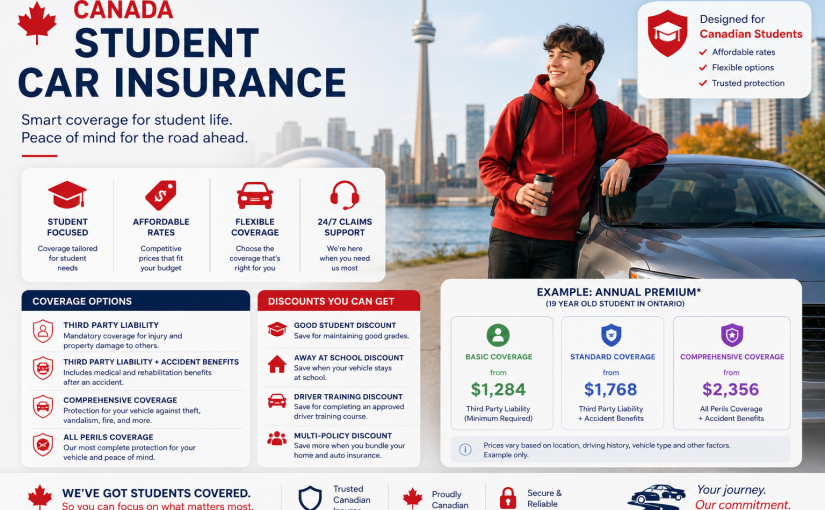
In Canada, car insurance is a significant expense for students. According to actuarial data from industry sources like Ratehub and RATESDOTCA, average premiums for young drivers can rise by as much as 142%, with extreme cases seeing spikes of up to 210%.
A key feature of the Canadian car insurance system is that it is entirely regulated at the provincial level. This means that whether you are attending school in Ontario, British Columbia (BC), or Quebec, you will encounter vastly different insurance laws, systems, and pricing structures.
The following is a comprehensive, in-depth guide covering every aspect of car insurance for students in Canada:
Core Foundation: Canada’s “Two-Track” Auto Insurance System and Student Policies
Auto insurance laws across Canadian provinces generally fall into two main categories: systems based on private-sector competition and systems based on government-run monopolies.
Private-sector competition camp (e.g., Ontario, Alberta, the Atlantic provinces)
Subject to free competition among private insurance companies (such as TD Insurance, Aviva, Intact, and belairdirect).
Ontario (ON): One of the most expensive regions in North America for student auto insurance premiums. Ontario employs a "Graduated Licensing System" (G1 → G2 → G). Under current regulations, premiums for G2 drivers can reach as high as $6,200 per year; however, upon passing the road test and upgrading to a full G license, drivers typically see an immediate, dramatic drop in premiums—ranging from 10% to 50%.
Alberta (AB): Employs a unique "Grid Rating System"; the law sets a maximum premium cap for novice drivers to protect young students from predatory market pricing, though overall costs remain relatively high.
Government-run public monopoly jurisdictions (e.g., British Columbia, Saskatchewan, Manitoba)
Exclusively operated by provincial state-owned companies (such as ICBC in British Columbia, SGI in Saskatchewan, and MPI in Manitoba).
The "Student Exemption" rule from ICBC (British Columbia):If you are a full-time student attending university in British Columbia after moving from another province or overseas, ICBC regulations allow you to be exempt from the requirement to switch to local license plates and insurance (a step usually mandatory for residents staying longer than six months). To legally drive your vehicle from your home jurisdiction while studying in BC, you simply need to obtain an MV23 Proof of Financial Responsibility form from your original insurance provider, pay a $30 fee to ICBC, and submit proof of enrollment (Form MV1804A).

Current Cost Status: A Comparative Analysis of Student Insurance Premiums Across Canadian Provinces
Based on data analysis from major Canadian auto insurance comparison platforms for 2026, here is a stark comparison between the average premiums for ordinary drivers and those for students (holding independent, full-coverage policies) across the provinces:
| Region/Province | Average annual insurance premium for an ordinary driver | Average annual premium for university students (individual policies) | Characteristics of the rate environment |
| Ontario | Approx. $1,505 | Approx. $4,144 | 💸 The most expensive in Canada. Student insurance premiums in the Toronto area (GTA) are extremely high. |
| Newfoundland and Labrador | Approx. $1,168 | Approx. $3,619 | ⚠️ Harsh geographical conditions; high accident rate among young drivers. |
| Alberta | Approx. $1,316 | Approx. $3,120 | ⚖️ Comprehensive insurance is expensive in Calgary and Edmonton due to the high frequency of hail and winter blizzards. |
| Nova Scotia | Approx. $891 | Approximately $2,237 | 🌲 Rates are relatively moderate, and competitive pressure in the Atlantic provinces is low. |
| Quebec | Approx. $717 | Approx. $2,114 | 💰 The cheapest in Canada. It employs a hybrid system where personal injury coverage is fully provided by the government (SAAQ), while property damage is covered by the private sector. |
| NB | Approx. $867 | Approx. $1,867 | 👍 Suitable for student drivers on a budget. |
Core Structure of Canadian Auto Insurance Coverage
Regardless of the province, student car insurance consists of the following four mandatory and optional components:
Third-Party Liability (Mandatory): Covers bodily injury or property damage caused to others due to your fault. While there are statutory minimums (e.g., C$200,000 in Ontario), due to the high value of legal claims in Canada, it is industry-standard practice for both international and local students to secure coverage of C$1 million or C$2 million.
Accident Benefits (Mandatory): Covers medical, rehabilitation, and funeral expenses for you, passengers (such as fellow students), or pedestrians involved in the accident, regardless of who was at fault.
Uninsured Automobile Coverage (Mandatory): Provides compensation if you are involved in a hit-and-run or a collision with an uninsured driver.
Direct Compensation Property Damage (DCPD) (Mandatory in some provinces): In Ontario and Alberta, if the other party is at fault, you do not need to sue them; instead, your own insurance company directly covers your vehicle repair costs, ensuring a highly efficient process.
Collision and Comprehensive Coverage (Optional): Covers repairs for your own vehicle resulting from collisions, as well as damage from events like hailstorms, broken windows, or theft (highly recommended given Canadian winters). If you own an older used car outright, you can opt out of these coverages to significantly reduce your premiums.
Unlock the ultimate "money-saving buff" for Canadian university students.
To counter high premiums, Canadian insurance companies offer the following compliant discounts within the legal framework; these discounts can be stacked:
Good Student Discount:
Requirements: Full-time university students must maintain an "A" average, a GPA of 3.0 or higher, or rank in the top 80% of their class.
Benefits: Companies such as belairdirect, Sonnet, and TD Insurance may offer direct premium discounts ranging from 10% to 25%.
Professional/Alumni Group Rates:
TD Insurance, Canada's largest provider of student auto insurance, boasts the country's most extensive network of university partnerships (including institutions such as U of T, UBC, Waterloo, and McGill). Current students and alumni of these prestigious universities can access exclusive "alumni/student channels" to obtain quotes and secure special rate discounts ranging from 5% to 15%.
Professional Driver Training Discount:
Enroll in a provincial government-approved "beginner driver education course" (such as Ontario's BDE program, commonly known as formal driving school training). Uploading your certificate of completion directly to your insurance company can typically shave hundreds of dollars off your premiums and shorten the waiting period for the road test within the graduated licensing system.
Telematics / Usage-Based Insurance:
Examples include Desjardins’ Ajusto or CAA’s MyPace. These programs use a mobile app to monitor hard braking, speeding, and mileage. Students who only drive short distances—such as commuting between their apartment and campus—can earn renewal discounts of up to 15%–30%.
Bundling Auto and Renters Insurance (Multi-Policy Discount):
Students renting off-campus in Canada are often required by their apartment complexes to purchase tenant insurance. Bundling car insurance and tenant insurance with the same provider (such as Sonnet or BrokerLink) can not only make the tenant insurance effectively free but also secure a 5%–12% discount on the car insurance.
A Guide for International Students in Canada: How to Avoid Pitfalls When Buying Insurance
If you are an international student moving to Canada alone—without a long-standing local credit history or driving record—you should pay special attention to the following points:
The legal validity of the "no-accident certificate" from your home country:
Private insurance companies in Canada place great importance on an applicant's "insurance history." If international students can provide a stamped and translated "No-Claim Letter" issued by an insurer in their home country, they may—by working with certain high-level insurance brokers in Ontario and Alberta—legitimately secure some credit for their prior driving experience. This allows them to avoid being immediately placed in the highest-cost risk category reserved for novice drivers.
Address and Parking Location Fraud (Rate Evasion):
Some students attending school in downtown Toronto—where insurance premiums are extremely high—list a classmate's address in London or Waterloo as their residence to save on costs. When processing claims, Canadian insurance companies rigorously verify the location of the accident, as well as attendance records provided by professors or semester-long rental contracts. If a falsified place of residence is discovered, the claim is immediately denied; furthermore, the student may face fraud charges and be reported to a national anti-fraud database, resulting in a blacklist across all Canadian insurers and potentially jeopardizing their Post-Graduation Work Permit (PGWP) and immigration applications.