
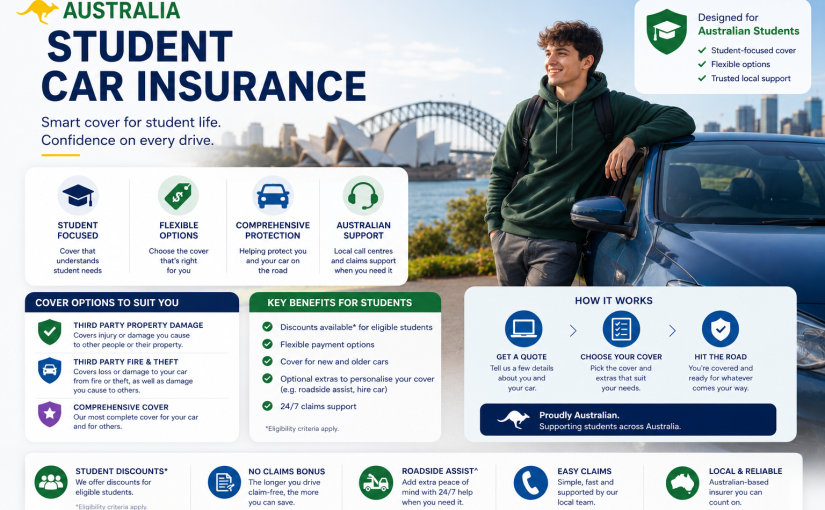
Navigating student car insurance in Australia is a complex undertaking. Not only do traffic regulations and insurance systems vary significantly across Australian states, but insurers also employ rigorous actuarial models and multi-tiered "excess" (deductible) structures specifically targeting young drivers under 25, holders of "P-plates" (provisional licenses), and international students.
According to the latest comprehensive market data from CHOICE—Australia’s leading consumer advocacy group—and major price comparison platforms, young drivers under the age of 26 face the highest average premiums across all age groups. This is due to their lack of driving experience and statistically higher accident rates; while they make up 14% of all license holders, they account for nearly 25% of traffic-related fatalities.
The following is a comprehensive, in-depth guide to student car insurance in Australia:
The Underlying Dual-Track System of Australian Car Insurance Law
When buying and driving a car in Australia, you must distinguish between two completely different types of insurance: statutory compulsory personal injury insurance and commercial property insurance.
Compulsory Third Party (CTP) Insurance:
All vehicles across Australia must have this coverage to be legally driven on the road. It covers people but not the vehicle itself (covering medical expenses and compensation for injuries or fatalities suffered by third parties or pedestrians due to your fault in an accident).
Due to differing administrative systems across the states, the methods for purchasing CTP insurance vary significantly:
New South Wales (NSW): Commonly known as "Green Slip." Vehicle owners must compare prices and independently purchase the policy from a private insurer (such as Allianz, QBE, or NRMA) before registering their vehicle ("Rego"). Premiums vary based on the driver's age, traffic violation history, and residential postcode.
Victoria (VIC): The CTP cost is known as the "TAC fee." It is mandatorily included in the annual vehicle registration bill and collected by the government authority (VicRoads); students do not need to—and cannot—select a separate provider.
Queensland (QLD) & South Australia (SA): CTP costs are also included in the registration bill, but the law allows you to select your preferred private insurer from a drop-down menu in the system when making the payment.
Western Australia (WA), Tasmania (TAS), Northern Territory (NT), & Australian Capital Territory (ACT): Managed entirely by state government monopolies; the cost is bundled directly with the vehicle registration fee.
Commercial Car Insurance:
CTP insurance does not cover damage to your own vehicle. If you crash into someone else's luxury car, or if your own car is stolen or vandalized, you must rely on the following three optional tiers of commercial vehicle insurance:
| Insurance Class | English Name | Scope of Coverage | Recommendations for Students |
| Comprehensive insurance | Comprehensive | Regardless of who is at fault: compensation for the other party's property, coverage for repairing or writing off your own vehicle, and coverage for damage such as broken windows, theft, or hail. | 🚙 An essential for new cars, financed vehicles, and high-value used cars. Given the frequency of hailstorms and kangaroo collisions in Australia, students are strongly advised to opt for this coverage. |
| Third-party fire and theft insurance | Third Party Fire & Theft (TPFT) | It covers only the other party's property damage, plus damage to your own vehicle—but only in the event of fire or theft. | ⚖️ Suitable for students looking for a "runabout" car costing a few thousand AUD, especially when parking in areas with average security. |
| Pure third-party property insurance | Third Party Property Damage (TPPD) | It only covers the other party's losses. If your car is wrecked, the insurance company won't pay a single cent. | 💰 Lowest premiums. Suitable for students driving very low-value older cars—where you wouldn't mind simply scrapping the vehicle if it broke down—but who are worried about the financial consequences of colliding with a luxury car. |

2026 Australia-wide Premium Ranking for Young Drivers Under 26
Due to variations in population density, road conditions, and local laws across states, students face significant geographical disparities in insurance premium costs. The following is a comparison of average annual premiums for young drivers under the age of 26 (purchasing standalone comprehensive policies) based on a representative market sample from early 2026:
| State/Territory | Average annual premium for those under 26 | In-depth Analysis of the Market Rate Environment |
| Victoria (VIC) | Approx. $3,614 AUD | 📈 The most expensive in Australia! The Melbourne metropolitan area is vast, features numerous "hook turns," and has an extremely high accident rate among students. |
| New South Wales (NSW) | Approx. $3,362 AUD | 🛑 Traffic in the areas surrounding Sydney is extremely congested; furthermore, Compulsory Third Party (CTP) insurance must be purchased separately, resulting in substantial overall vehicle ownership costs. |
| Northern Territory (NT) | Approx. $2,913 AUD | 🏜️ Roadside assistance costs in remote areas are high, and the rate of collisions with wildlife (kangaroos, cattle) remains consistently high. |
| South Australia (SA) | Approx. $2,612 AUD | ⚖️ Insurance premiums in Adelaide and the surrounding areas are relatively mid-range compared to the rest of Australia. |
| Western Australia (WA) | Approx. $2,597 AUD | 🦘 Insurance premiums in the Perth metropolitan area are reasonable, but road conditions become complex once you leave the city, and there is a high risk of collisions with wildlife. |
| Queensland (QLD) | Approximately $2,554 AUD | ☀️ The Sunshine Coast and Brisbane are frequently battered by extreme rainstorms and destructive hailstorms, causing comprehensive insurance premiums to be heavily influenced by weather conditions. |
| Australian Capital Territory (ACT) | Approx. $2,161 AUD | 🏛️ Canberra is well-planned; although there are many roundabouts, accidents tend to be relatively minor. |
| Tasmania (TAS) | Approx. $2,088 AUD | 🌲 The cheapest in Australia. Low population density, a slow pace of life, and a relatively low overall probability of insurance claims. |
The "Deductible Trap" for Students: Australia's Unique Mechanism of Layered Surcharges
In Australia, if you are involved in an accident and are deemed the at-fault party, you must pay an excess before the insurance company will begin repairs. For students and young drivers, Australian insurers apply punitive policy clauses involving "stacked" or multiple excesses:
Basic Excess:
Applies to everyone and typically ranges from $600 to $1,000; you can manually increase this amount when purchasing the policy to lower your premiums.
Age Excess — A major pain point:
If the driver involved in an accident is under 25 years old, the insurance company will impose an additional age-based excess—ranging from $500 to $1,200—on top of the basic excess.
Inexperienced Driver Excess:
If the driver (even if over 25) has held a full license for less than two years—such as local students who have just obtained their "P-plates" or novices recently using an overseas license—an additional fee (usually around $500) will be charged.
Unlisted Driver Excess:
If you drive a car belonging to your parents or a senior student without your name being explicitly listed on their policy (as a "Listed Driver"), and a crash occurs, you will not only have to pay the aforementioned excess amounts but also incur an additional penalty fee for being an unlisted driver.
💥 A real-life extreme case: A 19-year-old college freshman accidentally rear-ends another vehicle while driving a classmate's car (on which they are not listed as a driver). When filing a claim, they could face the following costs: a standard excess ($800) + an age surcharge ($600) + a novice driver surcharge ($500) + an unlisted driver surcharge ($500)—totaling $2,400 AUD in out-of-pocket expenses before the insurance company will step in. If the repair costs are less than $2,400, the insurance is effectively useless.
Pitfalls for International Students Buying Insurance in Australia
Many students traveling from China or other countries to study in Australia often run into trouble due to a lack of familiarity with the overlapping regulations of Australian transport and insurance authorities:
Conversion of Overseas Driver's Licenses and Compliance Regarding "Insurance Gaps":
Under laws recently tightened by various Australian states (such as NSW and Victoria), the period during which temporary visa holders (including international students) may drive using their original overseas driver's license accompanied by a translation (NAATI-certified) or an International Driving Permit (IDP) has been reduced to between three and six months (depending on the state).
Legal Consequences: If you reside in the state beyond the statutory time limit without obtaining a local provisional or full driver's license (L/P/Full Plate), you are legally considered to be driving unlicensed. In the event of an accident, commercial insurers will deny the claim entirely based on "illegal driving exclusion clauses," and your Compulsory Third Party (CTP) insurance may also become void.
"Rate Loading" for Overseas Driver's Licenses:
When calculating premiums, some Australian insurance companies (such as Everyday Insurance and Coles Insurance) classify drivers who do not hold a local Australian driver's license as a high-risk group, automatically applying an "Overseas Licence Loading" surcharge of 15% to 20%.
Strict 0.00% zero-tolerance policy for alcohol (BAC):
Australia enforces extremely strict zero-alcohol laws for Learner (L-plate) and Provisional (P-plate, Red P/Green P) drivers. If a driver in these categories tests positive for even a 0.01% blood alcohol concentration after drinking, they face not only the suspension of their license and criminal penalties but also the complete invalidation of their car insurance policy, resulting in a total denial of any payout.
Tips for International Students in Australia to Save Money on Car Insurance While Staying Compliant
Choose the Right Vehicle (Stick to Low-Risk Models):
When buying a used car in Australia, avoid high-performance vehicles—such as those with high-output engines, turbochargers, or V8s (laws in many states explicitly prohibit "P-platers" from driving high-performance cars). Prioritize mass-market models like the Toyota Yaris, Kia Picanto, or Honda Jazz; these have very low costs for parts and repairs, and carry the lowest base insurance rates in insurers' systems.
Take Advantage of "Limited Mileage" Policies (Pay As You Drive / Kilometre Option):
Many Australian insurers (such as Bupa, Allianz, and Real Insurance) offer comprehensive coverage based on mileage. If you primarily drive between campus, the supermarket, and your apartment—and commit to an annual mileage of under 5,000 or 10,000 kilometers—you can cut your premiums by 10% to 25%.
Online Discounts and Bundling Offers:
To attract new customers, the vast majority of Australian insurers offer an immediate 10%–15% "Online Discount" on the first year's premium if you enter your details and pay via their official website. Additionally, if you join a local motoring association (such as RACV in Victoria, NRMA in NSW, or RACQ in Queensland) and bundle their roadside assistance service with your car insurance, you can secure an extra member discount.
Protect Your No Claim Bonus (NCB):
Australia places great importance on credit history; if you drive safely and go 1–2 years without making an insurance claim, you can earn a significant NCB discount upon renewal. Some companies even allow you to submit proof of a claim-free driving history from overseas (requiring an official, notarized English translation) to customer service for review and potential premium reductions.